Reviewing Need Want Such a Fine Line Svg for Embroidery
As a designer who has spent years translating digital vectors into tangible thread, I approach every new file with a mix of curiosity and caution. The phrase "need want such a fine line" carries a weight that is both philosophical and visually striking. When I first loaded the Need Want Such a Fine Line Svg into my workspace, my immediate reaction was not just about the aesthetic appeal, but about its translatability. Can this delicate balance of sentiment survive the mechanical reality of an embroidery machine? This review breaks down the practical application of this design for those of us building craft businesses, creating personalized gifts, or managing small shop inventories.
The Visual Personality and First Impressions
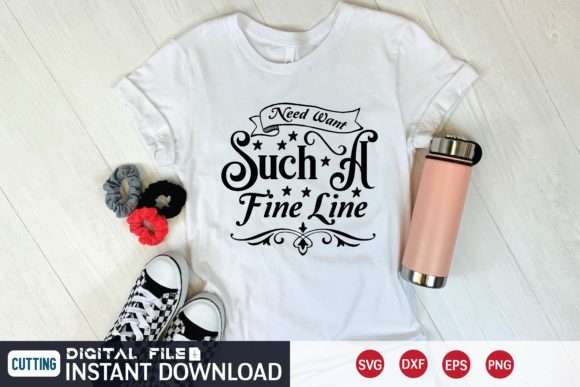
The mood of this design is introspective and modern. It does not shout; it whispers. For embroidery designers, this presents a unique challenge. The typography likely relies on clean lines and perhaps a minimalist layout to convey its message effectively. In the context of T-Shirt Designs, this kind of graphic stands out because it avoids the clutter often seen in mass-produced apparel. It feels like something a thoughtful customer would choose for a custom apparel order, perhaps for a friend going through a life transition or for themselves as a statement piece.
The visual personality here is versatile. It fits comfortably within the realm of contemporary handmade products. Whether you are envisioning it on a neutral-toned tote bag or as a subtle accent on a sweatshirt, the design’s strength lies in its simplicity. However, simplicity in digital graphics does not always equal simplicity in stitching. The "fine line" mentioned in the text must be carefully evaluated to ensure it does not disappear into the fabric texture or become lost in poor stitch density.
Real-World Application: The Custom Sweatshirt Scenario
Let us consider a real-life scenario. A client approaches your Etsy shop requesting a personalized gift for their partner who values mindfulness and minimalism. They want something wearable but meaningful. You select the Need Want Such a Fine Line Svg for a high-quality cotton blend sweatshirt. This is where the rubber meets the road.
Because this is an instant download cutting file compatible with software like Cricut and Silhouette, you might initially think of it for vinyl heat transfer. But as an embroidery reviewer, I am interested in how we adapt this for thread. If you are converting this SVG into a machine embroidery design, you must pay close attention to the stroke width. A line that looks crisp on a screen can become a gappy mess if the stitch count is too low or if the needle skips over textured fabric. For a sweatshirt embroidery project, using a satin stitch for the thicker elements and a careful running stitch for the finer details could preserve the integrity of the message.
The placement matters immensely. Centered on the chest, it acts as a focal point. On the sleeve, it becomes a subtle detail. For a boutique product, I would recommend testing it on the lower left hem of a hoodie for a more understated, high-end look. This positioning elevates the perceived value of the finished product, making it feel less like a promotional item and more like a curated fashion piece.
Navigating Fabric and Technical Constraints
One of the most critical aspects of using any new design asset is understanding its limitations. The Need Want Such a Fine Line Svg requires careful handling when applied to certain materials. If you are working with thin fabric, such as a lightweight tee or a silk blouse, the stitch density must be managed meticulously. Too much fill stitch can cause puckering, ruining the smooth drape of the garment. Conversely, on thick fabrics like denim or canvas tote bags, you need sufficient underlay stitches to prevent the design from sinking into the weave.
Textured fabrics pose another challenge. If you are creating holiday embroidery on a fuzzy fleece blanket, the fine lines of the text may get lost. In such cases, increasing the contrast with bold thread colors or adding a slight backing stabilizer can help maintain clarity. For curved surfaces like caps or hats, the design needs to be digitized with pull compensation in mind. A straight line in an SVG can bow outward when stitched on a curved cap brim, so adjustments are necessary to keep the text legible.
Dark fabrics require special attention to thread colors. A dark gray thread on a black shirt might look sophisticated in a mockup but vanish in real life. Always test your thread color contrast on scrap fabric before committing to the final piece. This is a non-negotiable step for any professional embroidery project aiming for customer trust and satisfaction.
Commercial Viability and Brand Consistency
For small business owners and creative entrepreneurs, the commercial potential of this design is significant. It appeals to a demographic that values authenticity and mental well-being. As an Etsy seller, you can leverage this design across multiple product lines. Imagine it on an apron for a cooking enthusiast, a pillow cover for home decor, or even as part of a nursery decor set for parents who appreciate mindful parenting.
The key to successful commercial embroidery is consistency. If your brand focuses on minimalist, high-quality handmade products, this design aligns perfectly. It enhances brand recognition by offering a cohesive visual language. However, you must confirm licensing before selling finished items. Since the product description notes it is compatible with various cutting software, ensure that your specific use case—whether it is creating physical embroidered patches or digital embroidery files for resale—is covered under the license terms provided by the creator.
Practical Designer Notes for Best Results
Before you launch this design into your production workflow, consider these practical steps:
- Test on Scrap Fabric: Never skip this step. Check how the stitches interact with your specific material.
- Check Stitch Density: Ensure the design is not too dense for lightweight fabrics or too sparse for durable goods.
- Inspect Small Details: Zoom in on the digital file. Are there tiny anchor points that might cause thread breaks?
- Use Proper Stabilizer: Match your stabilizer to the fabric type. Cut-away for stretchy fabrics, tear-away for stable woven materials.
- Mockup in Black and White: This helps you see the contrast and structure without the distraction of color.
- Verify Hoop Size: Ensure the design fits comfortably within your machine’s hoop without requiring excessive re-hooping.
In conclusion, the Need Want Such a Fine Line Svg is a compelling addition to your library of graphics. It offers a blend of emotional resonance and visual clarity that, when handled with technical precision, can elevate your embroidery projects. Whether you are creating a single personalized gift or scaling up for a small shop product line, treating this design with the respect it deserves will result in a finished product that customers cherish. Remember, the difference between a good design and a great embroidered item lies in the details of execution.